
| Land Resource Unit Description Land Resource Unit 41-3AZ - Arizona Semi-Desert Grassland |
 |
 |
Land Use:
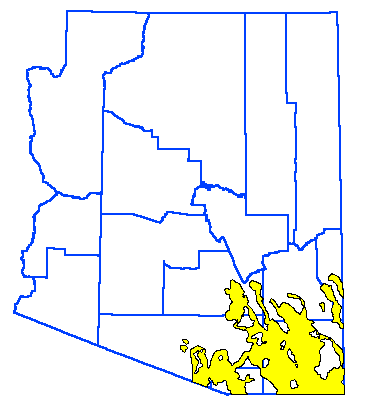
There are approximately 5,646,000 acres in this resource unit. Land ownership in this resource unit is a diverse mixture of federal, state, and private lands. Most of this area is rangeland, with a moderate cover of warm season perennial grasses and, in places, an over-story of mesquite or creosotebush and whitethorn.
Nearly all of this resource unit is grazed year round by cows and nearly all ranches utilize some form of grazing rotation to maintain animal numbers and range condition.
Recreational uses of wildlife are important activities on rangeland in this area. Economic big game species include javelina, desert mule deer, pronghorn antelope, Coues whitetail deer, and desert bighorn sheep. Small game include Gambel's and scaled quail, mourning dove, cottontail, and jack rabbits. These animals account for thousands of hunter days. Over 12,000 sandhill cranes winter in the Willcox Playa and the cienegas in the Sulphur Springs Valley.
Mining, especially for copper, is an important land use in this resource unit. Substantial ore bodies remain, waiting for new extraction techniques, environmentally safe processing, and or improving economics to be exploited. Other important minerals include gold, silver, molybdenum, turquoise, opal and other mineral specimens.
Numerous materials operations utilize natural products, like sand, gravel, rock, clay, limestone, marble, gypsum, decomposed bedrock, cinders and boulders for landscaping.
Elevation and Topography:
Elevations range from 3200 to 5000 feet on the level up to 6000 feet on steep, southern exposures of mountain ranges. Broad, moderately sloping , dissected fans of old alluvial extend from the relatively narrow, recent alluvial flood plains to the base of abruptly rising mountain ranges. The flood plains are narrow ranging in width from 1/2 to 2 miles. The old dissected fans are extensive, making up the remaining 10 to 20 miles between mountain ranges. The mountain ranges are composed of granite, basalt, schist, andesite, and limestone parent materials.
The drainage pattern is well developed throughout the area. A closed drainage system occurs around the Willcox Playa with numerous small streams spreading out on the alluvial fans flanking the lake bed. Major streams, like the Santa Cruz, San Pedro, Whitewater Draw, and Black Draw, pass through this resource unit, and have well developed tributaries.
Climate:
Precipitation in the resource unit ranges from 12 to 16 inches per year in the eastern part with elevation from 3600 to 500 feet. Precipitation in the western part ranges from 13 to 17 inches yearly with elevations from about 3300 feet to 4500 feet. Winter - summer rainfall ratios range form 40-60 in the west side of the resource unit, to 30-70 in the eastern portion of the area. Summer rains fall July - September, originate in the Gulf of Mexico, and are convective, usually brief, intense thunderstorms. Cool season moisture originates in the Pacific and Gulf of California, tends to be frontal, and falls in widespread storms with low intensity and long duration. Snow rarely lasts more than one day. May and June are the driest months of the year. Humidity is generally very low.
Temperatures are mild. Freezing temperatures are common at night from December through April. However, temperatures during the day are frequently about 50 degrees F. Occasionally in December to February, brief 0 degree F temperatures may be experienced some nights. During June and rarely during July and August, some days may exceed 100 degrees F. Frost free periods range from 170 to 220 days.
Water Resources:
The San Pedro and Santa Cruz Rivers run through the central and western portions of this land resource unit. The San Pedro is a live stream for some distance after it enters the United States from Mexico. The Santa Cruz River is an intermittent stream. Sufficient groundwater is present along the lower portions of the larger valleys to permit pumping for irrigation water. Water in general is scarce.
Soils:
Argids are deep, well drained, moderately coarse to moderately fine textured soils, with thermic temperature regimes and mixed mineralogy. Paleargids (Tubac serices) are on the nearly level, lower ends of the long alluvial fans, while the Haplargids (Sonoita, Continental, and Pinaleno series) are near the middle and upper edges of the fan terraces.
Orthids are deep, well drained, moderately coarse to moderately fine textured, limy soils, with thermic temperature regimes and mixed mineralogy. Calciorthids (Latene, Nickel, and Karro series) are found in the middle portions of the long alluvial fans. Paleorthids (Cave series) are found on the upper parts of the fans.
Potential Natural Vegetation:
Potential plant communities in this resource unit are dominated by warm season perennial grasses. The major species are sideoats, black, blue, hairy, sprucetop and rothrock gramas, plains lovegrass, cane beardgrass, Arizona cottontop, plains bristlegrass, sacaton, alkali sacaton, tobosa, vine mesquite, curly mesquite, bush muhly and mesa, blue, red, poverty, and spidergrass threeawns. Average annual production of these grasslands is about 1000 pounds per acre.
Important shrubs include false mesquite, range ratany, shubby buckwheat, fourwing saltbush, soaptree yucca, and sacahuista. Mesquite is the dominant tree of the area with other common trees including catclaw acacia, netleaf hackbery, western soapberry, desert willow, Arizona ash, Arizona black walnut, cottonwood, and black willow.
Sonoran desert influences on the west side of this resource unit result in the occurrence of shrubs like jojoba, blue palo verde, staghorn and jumping cholla, and fishhook barrel cactus in the plant communities.
Chihuahuan desert influences on the east side of the resource unit result in the occurrence of shrubs like mariola, mortonia, chittam, tarbush, whitethorn acacia, and littleleaf sumac in the plant communities.
Summer annual grasses are important in the area and include species of grama, panic, sprangletop, and threeawn. Perennial forbs are also important in these plant communities and include species like evolvulous, sida, dychoriste, wild bean, lotus, matweed, zinnia, hog potato, perezzia, cudweeds and vetch.